
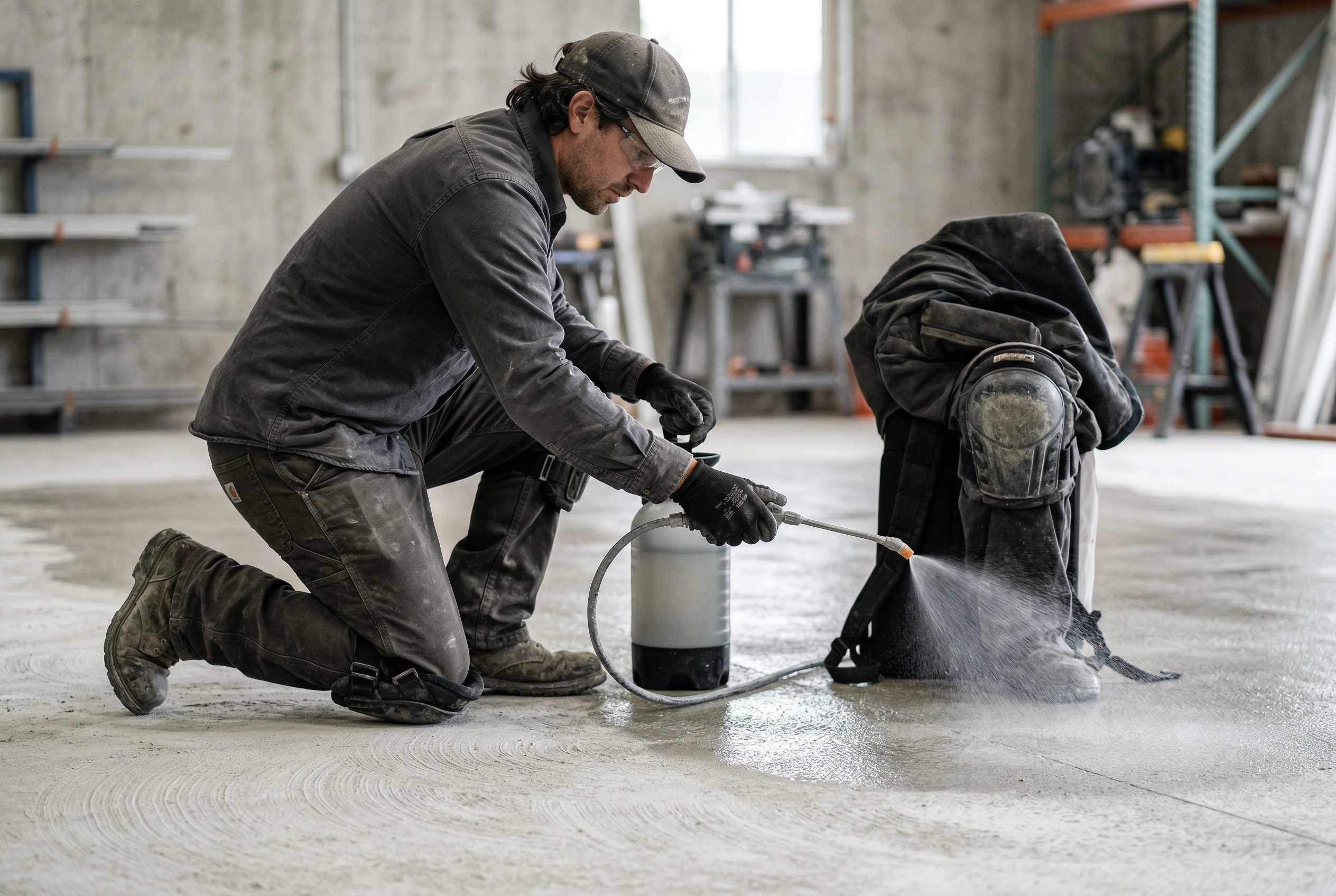
If you have ever stood in a Toronto warehouse and watched a polished concrete floor reflect the overhead lights like a still pond, you have seen what a densifier does. Without one you get a dusty, porous slab that scratches easily. With one you get the floor in our Toronto polishing projects. Densifiers are the quietest, most misunderstood step in the polishing process, and they are the difference between a floor that lasts five years and a floor that lasts twenty.
What a concrete densifier actually does
Concrete is full of microscopic pores. Inside those pores sits free calcium hydroxide left over from the curing reaction. A densifier is a clear liquid (lithium, sodium or potassium silicate) that soaks into those pores and reacts chemically with the calcium hydroxide. The reaction forms calcium silicate hydrate, abbreviated CSH, which is the same compound that gives concrete its strength in the first place. The pores fill in. The surface gets harder. Light reflects off it instead of scattering through dust.
That is the entire trick. No coating, no resin, no film. Just a chemical reaction that turns the top few millimetres of your slab into something closer to stone than to concrete.
The three densifier chemistries
Almost every densifier on the Canadian market is built around one of three silicates. They are not interchangeable, and the wrong choice on the wrong floor is one of the most common reasons a polishing job comes back looking patchy a year later.
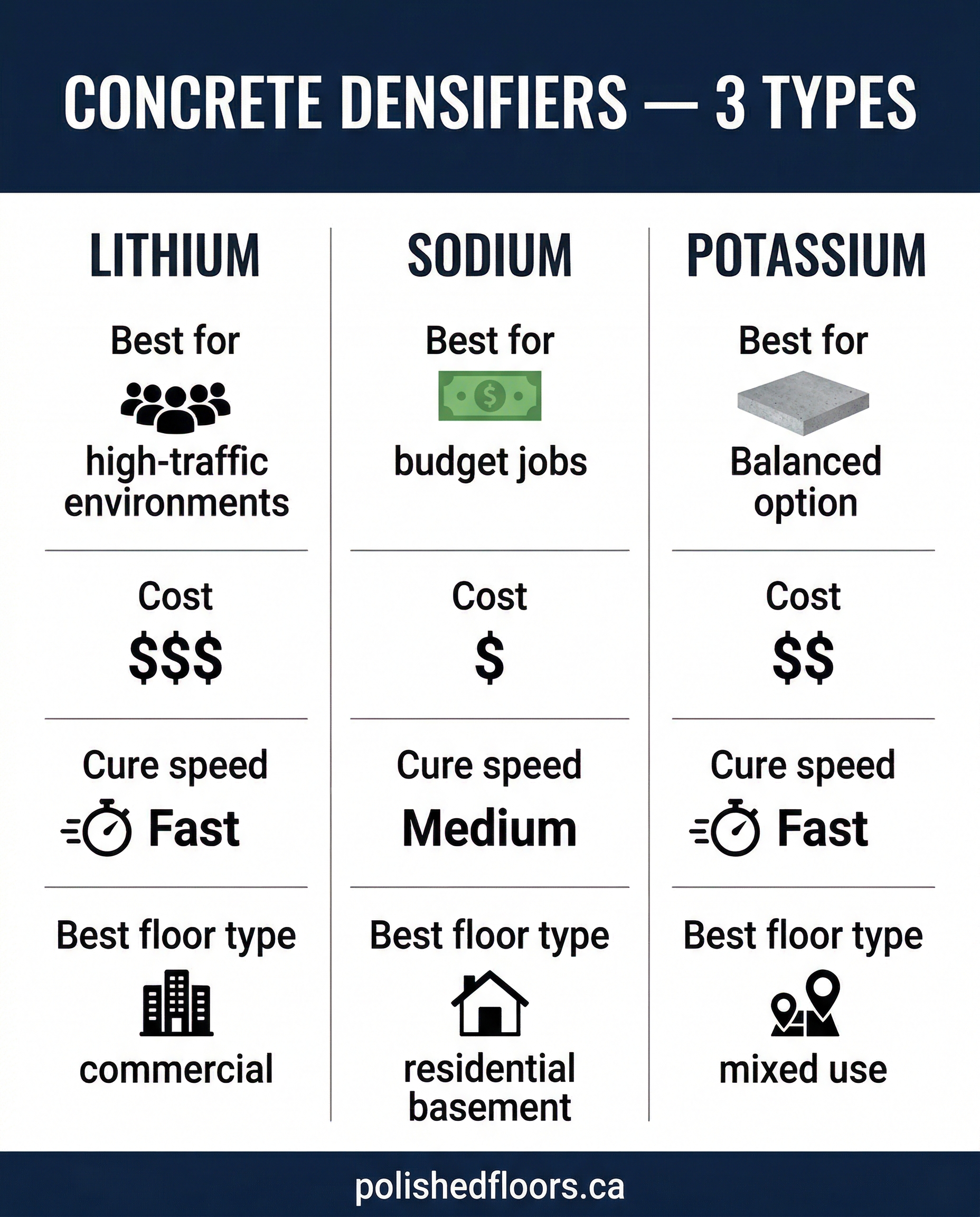
Lithium silicate
The newest of the three and the one most pros reach for first. Lithium has the smallest molecule, which means it penetrates deeper than the other two. It reacts faster, leaves almost no surface residue, and does not require as much rinsing or buffing. The downside is cost: lithium runs about 0.45 to 0.80 dollars per square foot in materials alone, roughly twice what sodium silicate costs. For high-traffic commercial slabs (warehouses, retail, food service) it is worth every penny because the floor needs almost no second application.
Sodium silicate
The original densifier and still the cheapest. Sodium silicate works, but the molecule is larger and reacts more slowly, so it tends to sit on the surface longer and leave a whitish residue if you do not buff it properly. Most contractors who still use sodium are doing residential basement jobs where budget matters more than the very last 5 percent of finish quality. If your installer is quoting a residential basement under 1,000 square feet and using sodium silicate, that is normal and not a red flag.
Potassium silicate
The middle option. Faster cure than sodium, smaller molecule than sodium, less expensive than lithium. Potassium is the workhorse for mixed-use spaces (a small commercial unit, a craft brewery taproom, a garage that doubles as a workshop). It is also the most forgiving for installers learning the trade, because the working window is longer than lithium.
When in the polishing process do you apply it
Densifier goes on after the 200 grit grinding pass and before the 400. That is the standard sequence in the Concrete Polishing Association of America (CPAA) protocol that most reputable Toronto floor polishing contractors follow. Apply too early and you are sealing in dust and grinder marks. Apply too late and the pores are already partially closed by the polishing pads, so the densifier cannot get in.
The slab also has to be at least 28 days old. Green concrete still has too much moisture moving up through it, and the densifier reaction goes sideways. Anyone who tells you they will polish a slab the week it was poured is either inexperienced or cutting corners.
How a densifier is actually applied
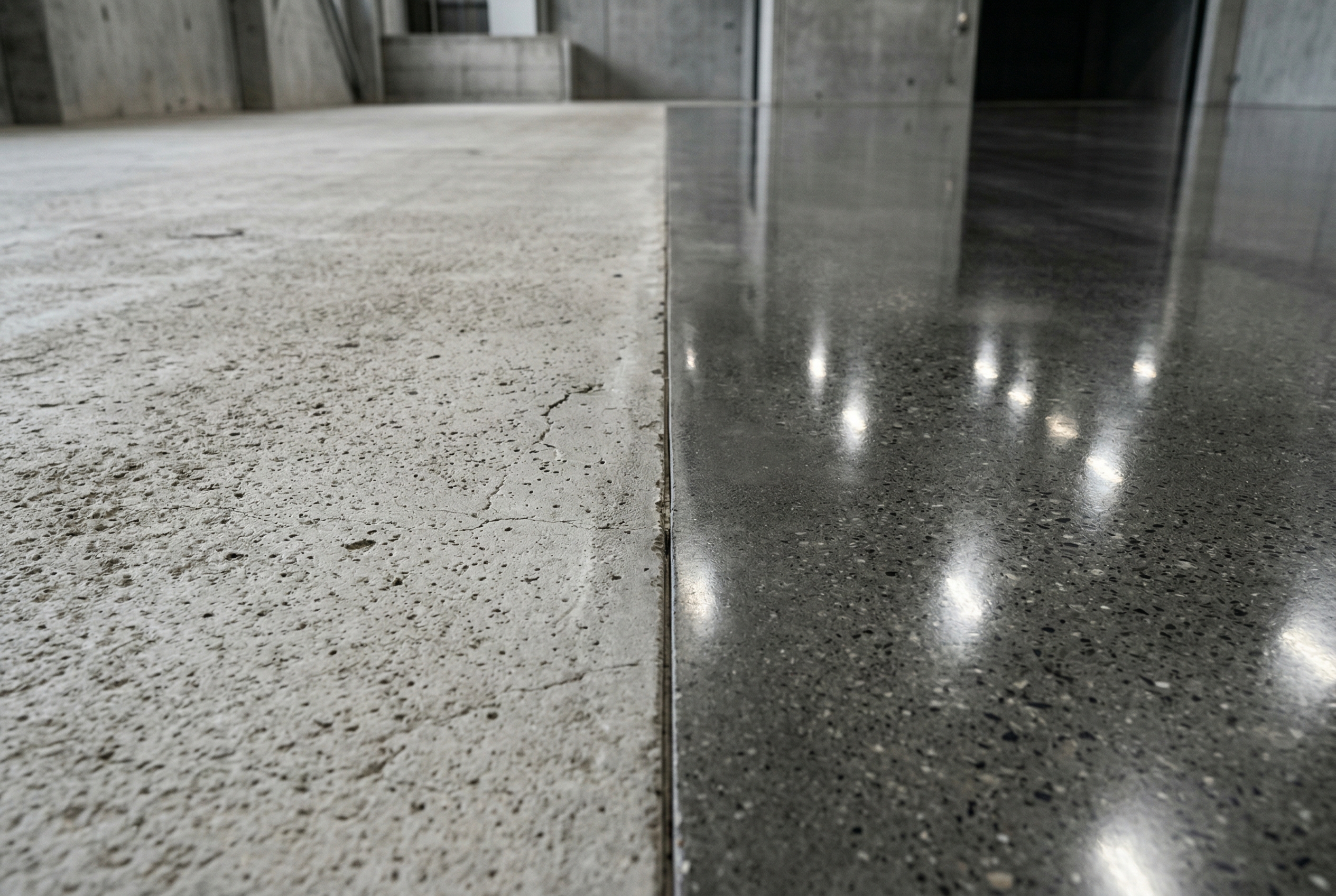
Watching a crew apply densifier looks anticlimactic. They wet the floor with a low-pressure pump sprayer until the surface is saturated but not pooling, then they keep it wet by misting for 20 to 30 minutes so the chemistry has time to react. After it dries they buff with a high-speed burnisher. That is it. No fans, no heaters, no curing tents.
The two things that go wrong are too much product (whitish residue you cannot buff off) and too little contact time (the floor still dusts a month later because the reaction never finished). A good crew watches the floor instead of the clock and adjusts as they go.
What a densified floor needs from you
Here is the part most homeowners and facility managers get wrong. A polished, densified concrete floor is not a sealed floor. It still benefits from a good neutral pH cleaner once a week and a stain-guard sealer top-up every 12 to 24 months in heavy traffic areas. The densifier handles abrasion and dusting. The stain guard handles oil, wine, coffee, and rock salt slush. They work as a team.
If you skip the stain guard re-application you will see dark patches show up first along main walking lines and around door entries. That is not the densifier failing. That is the top film wearing off because nobody renewed it.
Picking a densifier for your floor
For most GTA jobs the decision tree is short. Commercial or industrial slab over 5,000 square feet: lithium. Residential basement under 1,500 square feet on a tight budget: sodium. Anything in between or with mixed use: potassium. If a contractor cannot tell you which silicate they are using and why, that is a sign to keep shopping.
FAQ
How long does a concrete densifier last?
The chemical reaction is permanent. The CSH that forms inside the slab does not break down. What wears off is the polish above it and the stain guard, and those need topping up every one to two years in commercial spaces.
Can I apply a densifier myself?
You can apply the chemical, but you cannot polish the floor afterward without commercial diamond grinding equipment, and the polish is what makes the densifier visible. DIY densifier on a rough slab is wasted product.
Will a densifier stop my concrete floor from dusting?
Yes, that is one of its main jobs. A properly densified slab stops releasing dust from the surface within a week of application.
Does a densifier change the color of the concrete?
No. It is colorless. The slab will look slightly darker while wet during application and return to its natural shade as it dries. Any color change in a polished floor comes from the original concrete pigment or from a stain applied separately.
Is densifier the same as a sealer?
No. A sealer sits on top of the slab and forms a film. A densifier soaks in and chemically becomes part of the slab. Most polished concrete floors get both, but they do different jobs.
Note: All costs are approximate and may vary based on scope, materials, and site conditions – contact us for a detailed quote tailored to your project.
Download PDF