
1. The “Cold Concrete” Shock (Thermal Expansion)
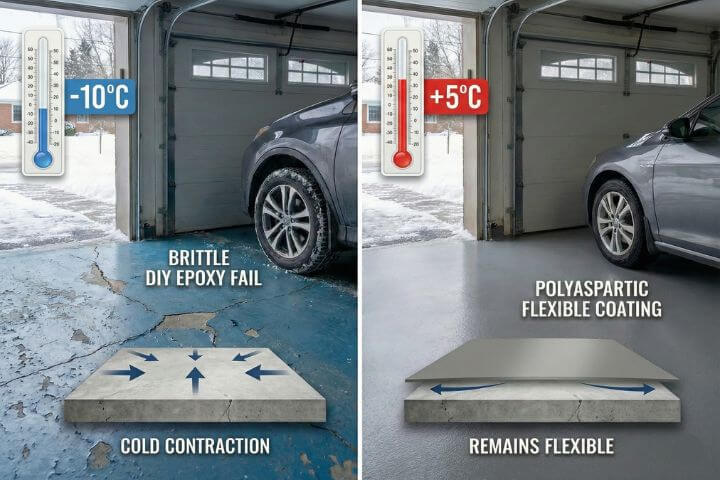
Here is the science: Concrete is like a rigid sponge. It expands when it’s hot and contracts when it’s cold.
In a typical Toronto winter, we swing from -10°C to +5°C rapidly. When you open your garage door to park your car, that rush of cold air hits the slab. The concrete contracts.
The Problem: Cheap epoxy (especially the DIY kits from big-box stores) becomes brittle in freezing temperatures. It loses its flexibility. When the concrete slab underneath moves or shrinks, the rigid epoxy can’t move with it. Instead of stretching, it snaps and delaminates (separates) from the concrete.
The Pro Insight: This is why at Polished Floors, we often recommend Polyaspartic or Polyurea coatings for Toronto garages. Unlike standard epoxy, these materials remain flexible even in extreme cold, allowing them to move with your concrete rather than fighting against it.
2. The Road Salt & Brine Effect
Toronto road crews don’t mess around with salt. They use a heavy brine mixture (magnesium chloride or calcium chloride) to melt ice. You drive through it, and then you park your car in the garage.
That salty slush melts off your wheel wells and sits in a puddle on your floor.
The Problem: If your floor coating has even a microscopic pinhole or a weak bond, that brine will find a way underneath. Salt crystallizes as it dries. When salt crystals grow under the coating, they exert massive pressure enough to pop the coating right off the concrete. This is called crystallization spalling.
3. The “Hidden Moisture” (Hydrostatic Pressure)
This is the number one killer of epoxy floors in the GTA, specifically in North York and Scarborough where the water table can be high.
Concrete is porous. Ground moisture from the earth constantly pushes upward through the slab, trying to evaporate. This is called Hydrostatic Pressure.
The Problem: If you apply a standard epoxy over a slab that has high moisture vapor transmission, you are essentially capping a geyser. The moisture pushes up, hits the impermeable epoxy layer, and has nowhere to go. It builds pressure until it literally blows the coating off the floor.
The Pro Insight: A true professional never guesses. We perform a Moisture Vapor Transmission rate (MVT) test before laying a single drop of coating. If the moisture is too high, we must apply a specific “Moisture Mitigating Primer” first. If your installer didn’t test for moisture, they were gambling with your money.
4. The “Prep” Was Non-Existent
I cannot stress this enough: 90% of floor failure happens because of poor surface preparation.
Many DIY kits tell you to “acid etch” the floor (pour some acid, scrub it, and rinse). In the professional world, we consider acid etching to be practically useless for durable garage floors.
Why Acid Etching Fails:
- It doesn’t open the “pores” of the concrete enough for the epoxy to soak in.
- It leaves the concrete wet (see point #3 about moisture).
The Solution: To get a bond that survives a Toronto winter, the concrete must be mechanically ground using diamond grinders. Think of it like sanding wood before painting; if the concrete is too smooth, the epoxy has nothing to “grab” onto. It just sits on top like a sticker, waiting to peel off.
5. It Was Applied Too Cold
We all rush to get home renovations done before the snow flies. But applying epoxy in late October or November in an unheated garage is a recipe for disaster.
Epoxy relies on a chemical reaction to cure. If the slab temperature (not just the air temperature) drops below 10-13°C, that chemical reaction slows down or stops completely. The epoxy may look hard, but it hasn’t actually bonded to the concrete. The first time you drive a hot tire onto that cold, uncured floor, the tire picks the epoxy up right off the ground (known as Hot Tire Pickup).
How to Ensure It Doesn’t Happen Again
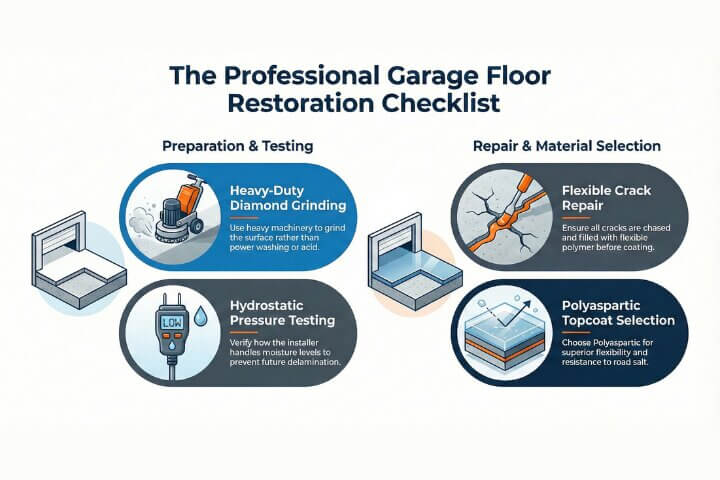
If you are looking to fix a peeling floor or install a new one, here is your checklist. Do not hire anyone who skips these steps:
- Diamond Grinding: Ensure they use heavy machinery to grind the floor, not just a power washer or acid.
- Moisture Testing: Ask them how they handle hydrostatic pressure.
- The Right Material: For unheated Toronto garages, ask for a Polyaspartic topcoat for flexibility and salt resistance.
- Crack Repair: Ensure all cracks are chased and filled with a flexible polymer before coating. We treat concrete repair as a critical first step.
Your floor should be a “once in 15 years” investment, not an annual headache.
Ready for a floor that actually lasts?
Stop the peeling cycle and get a surface engineered for the Toronto climate. Contact Our experts at Polished Floors today for a professional assessment and a coating that stands the test of time.