
A garage floor coating in Toronto has to survive things that floors in California or Florida never see: road salt baked into rubber tires, slush puddles that sit for hours, and seven months a year where the concrete underneath swings between minus 20 and plus 5 every week. That is why the epoxy vs polyaspartic question matters more here than almost anywhere else in North America. If you are weighing a coating for your own garage, take a look at our Etobicoke garage epoxy service for context, then read on. The honest answer is not the same for every garage.
Quick definitions
Epoxy is a two-part thermoset resin (resin plus hardener) that cures into a thick, hard plastic film. It has been the default garage coating in North America for 40 years. Polyaspartic is a newer aliphatic polyurea, technically a cousin of polyurethane, that cures dramatically faster and resists UV light without yellowing. Polyaspartic only became common in residential garages around 2010, which is why most homeowners still default to thinking epoxy is the standard.
Both coatings can be installed with decorative flakes broadcast into the wet coat, both can have a clear top layer, and both can be installed by a competent crew in a weekend. The differences only show up over time, and Toronto winters expose those differences faster than almost any climate on the continent.
Install time and cure
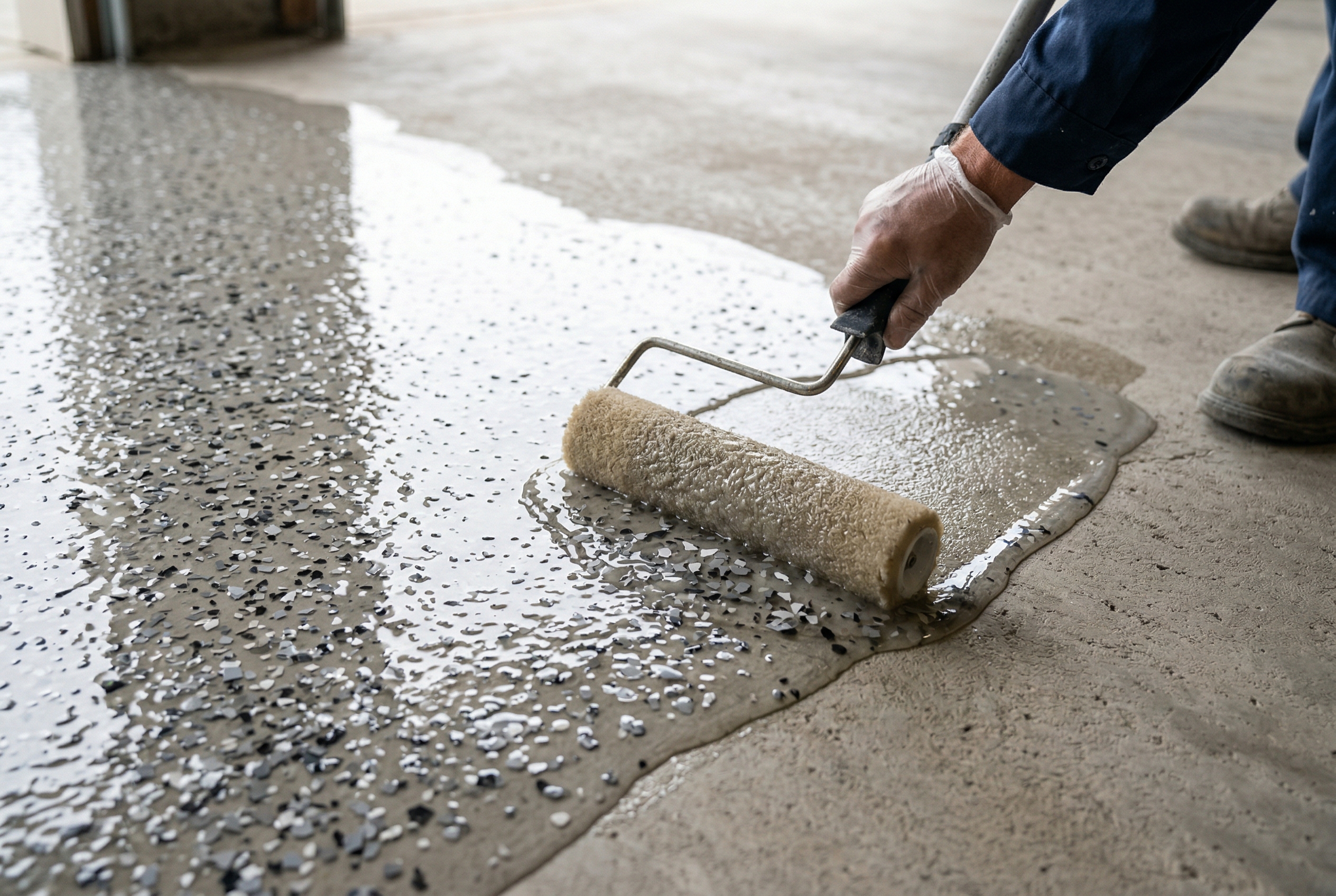
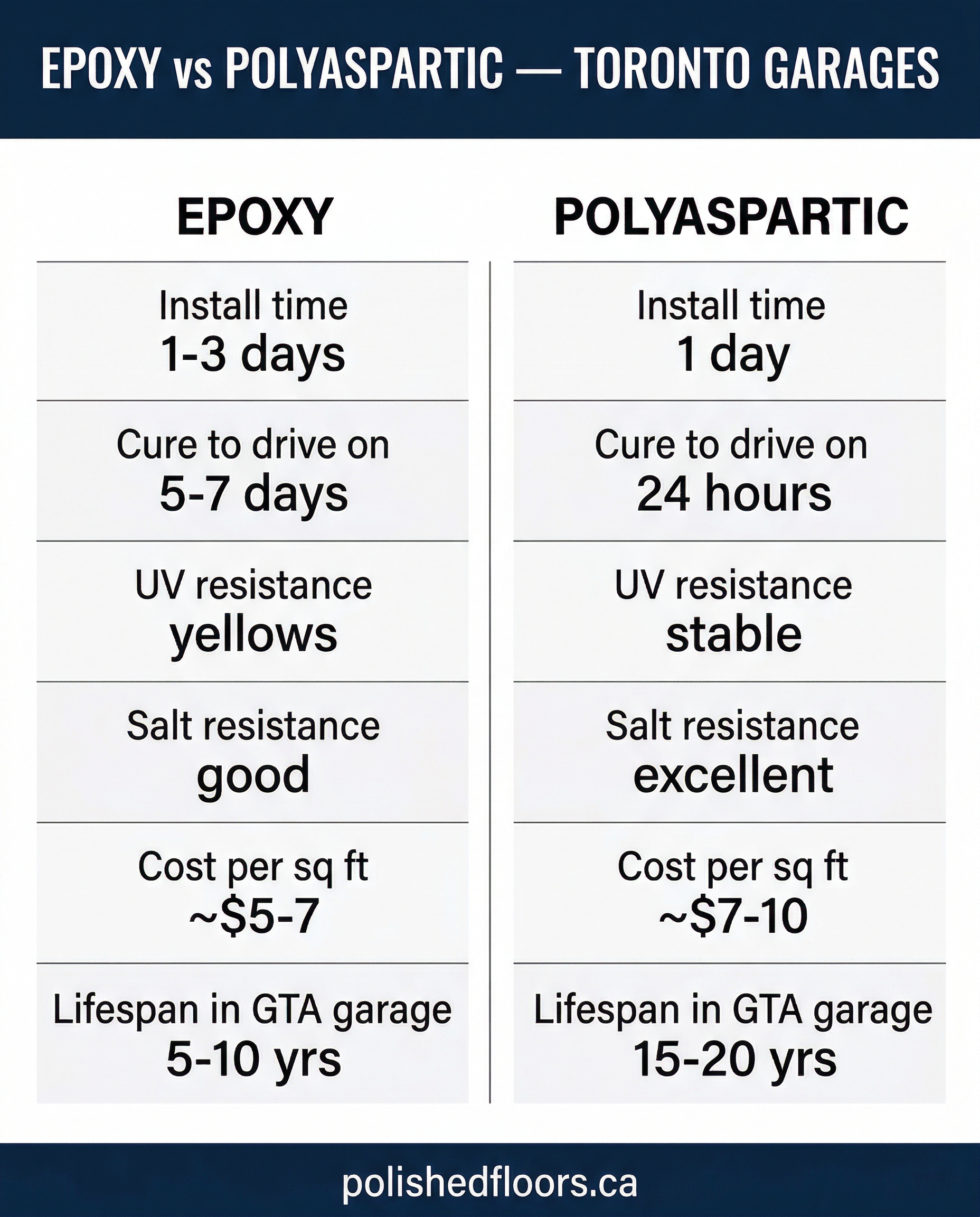
This is the gap most people notice first. A standard residential epoxy install takes two to three days: prep and primer day one, base coat with flakes day two, clear topcoat day three, then 5 to 7 days of cure before you can park a car on it. A polyaspartic install fits into a single day for the same garage: prep and primer in the morning, base coat with flakes by mid-afternoon, clear topcoat before dinner, and you can drive on it the next morning.
For a Toronto homeowner who has one car and no second garage to park in, the polyaspartic timeline is genuinely a different experience. You hand the keys to the installer at 8 a.m., you drive in the next day. With epoxy you need to find somewhere else to keep the car for a week.
Salt resistance and freeze-thaw
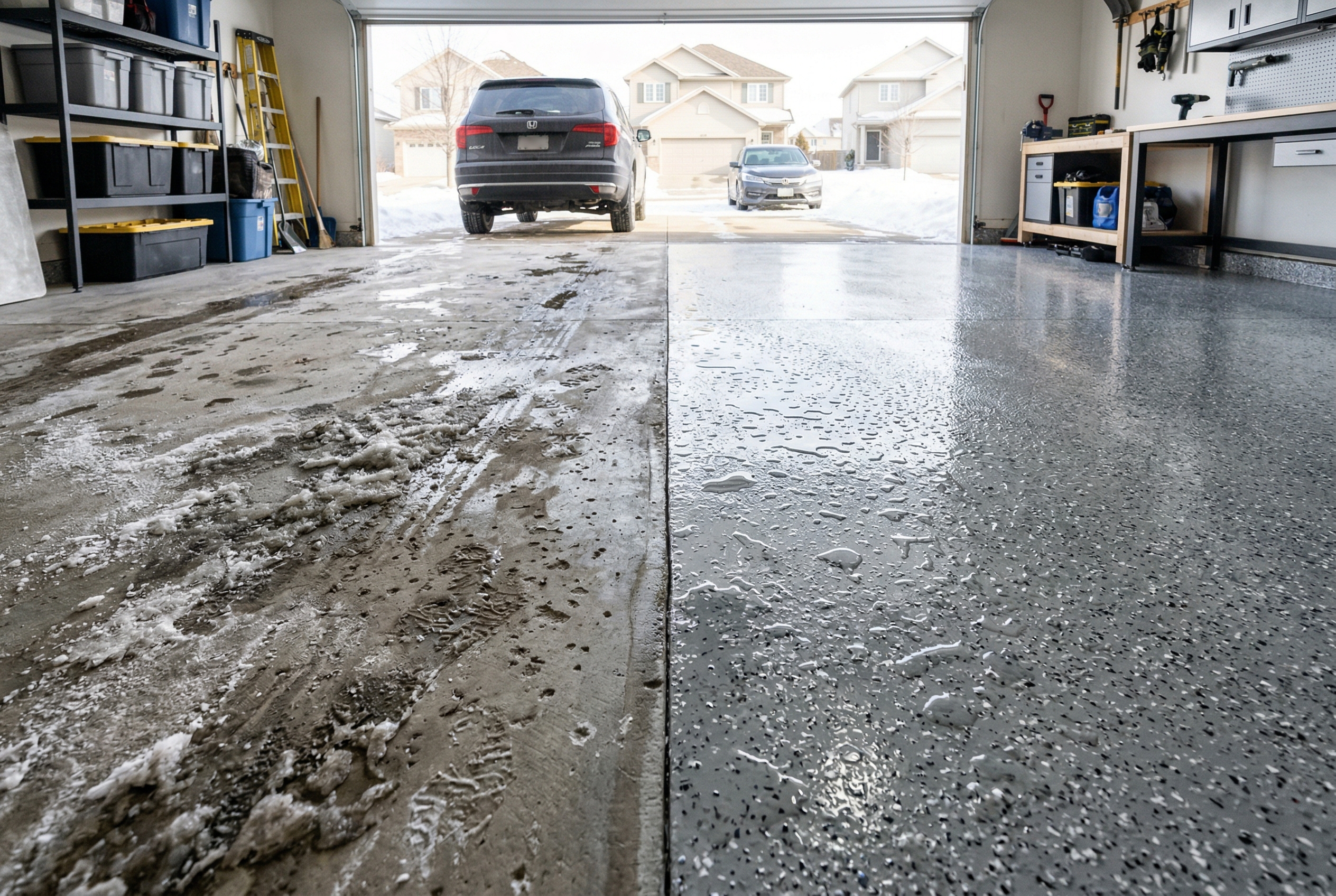
This is the part the marketing brochures will not tell you straight. Epoxy resists road salt fine when it is intact, but its weakness is the edges and any chip or scratch. Once salt brine finds an edge it works underneath the film and starts to lift it from the concrete. Polyaspartic has better edge adhesion and a more flexible film, so it tolerates the freeze-thaw cycle without lifting.
In our installs across the GTA we typically see epoxy garage floors start to show edge lift and chipping at the door threshold around year 5 to 7. Polyaspartic floors at the same age usually still look new. That is the single most important real-world data point if you park a winter daily driver inside.
UV stability and yellowing
If your garage door has windows or stays open during the day, sunlight matters. Epoxy is aromatic, which means UV light breaks down its molecular bonds and the clear top coat turns yellow over time. A black flake floor with a yellowed clear coat looks dingy and brown. Polyaspartic is aliphatic, which means it is UV stable and stays clear for the life of the floor.
Some installers offer epoxy with a polyaspartic clear topcoat as a hybrid. That solves the UV problem and lowers cost compared to full polyaspartic, but you still have the slower cure of the epoxy base coat underneath, and you still have the salt-edge weakness at the threshold.
Cost per square foot
Materials only, full epoxy systems run about 5 to 7 dollars per square foot in the GTA in 2026. Full polyaspartic systems run about 7 to 10 dollars. For an average two-car residential garage of 480 square feet that is roughly 2,400 to 3,360 dollars for epoxy and 3,360 to 4,800 dollars for polyaspartic.
The lifetime math is what matters. If epoxy lasts 5 to 10 years in a salt-exposed garage and polyaspartic lasts 15 to 20, the cost per year of polyaspartic is lower despite the higher upfront price. If your garage is unheated and you only park a fair-weather car, epoxy is the better value.
The thing that matters more than either coating
Surface prep. Both epoxy and polyaspartic fail when they are installed over poorly prepared concrete. The standard is mechanical diamond grinding to CSP-3 profile. Acid etching does not produce a strong enough bond for either coating in a Toronto winter, full stop. If a quote includes the words “acid wash” or “acid etch” instead of “diamond grind,” that is a red flag regardless of which coating they are selling you. A 5 dollar polyaspartic over an acid-etched slab will fail before a 5 dollar epoxy over a properly ground slab.
The other prep checkpoint is moisture. A calcium chloride test (ASTM F1869) takes 72 hours and tells you whether moisture vapour from below the slab will push the coating off later. Reputable installers run this test before quoting. Cheap installers skip it and you pay for the failure two winters later.
Which one for your garage
The honest decision tree for the GTA: if you park a winter daily driver in the garage and you want one install to last 15 plus years, polyaspartic. If your garage is heated workshop space or a fair-weather car only and you want to save 1,000 to 1,500 dollars, epoxy with a polyaspartic clear topcoat is a fine middle ground. If you are quoted full epoxy with no polyaspartic anywhere in the system, ask the installer why before you sign.
FAQ
Can I install polyaspartic over an existing epoxy floor?
Sometimes, if the epoxy is fully intact and well bonded. The existing surface needs to be sanded for adhesion and any chips or lifted edges have to be ground out and patched first. If more than 10 percent of the existing epoxy is failing, full removal is the better call.
Does polyaspartic really cure in one day in Toronto winters?
In a heated garage, yes. Polyaspartic cures by chemical reaction, not by evaporation, so it does not need warm air the way epoxy does. We routinely install in attached garages at 15 to 18 degrees C with no portable heat and the floor is drive-ready the next morning. Detached unheated garages need supplemental heat in January and February.
Will road salt eat through a polyaspartic coating?
No. Polyaspartic is chemically inert to road salt. What can happen is salt brine working into a chip or a poorly sealed expansion joint and lifting the coating from below. Keep the coating intact and salt is not a problem.
Can I pressure wash a coated garage floor?
Yes, both coatings handle pressure washing. Use a wide fan tip and keep the wand at least 12 inches from the surface. Avoid rotary tips on either coating, they can score the clear top layer.
How long should a garage floor coating warranty actually be?
For a residential GTA install, look for a minimum of 10 years on polyaspartic and 5 years on epoxy. Anything shorter than that and the installer does not believe in their own product. Anything advertised as “lifetime” without a clear written list of what is covered is marketing language, not a real warranty.
Note: All costs are approximate and may vary based on scope, materials, and site conditions – contact us for a detailed quote tailored to your project.
Download PDF