
What is concrete sweat? It is the layer of moisture that shows up on a concrete or polished floor when warm, humid air meets a slab that sits below the dew point, and the water vapour in that air condenses straight onto the surface. The floor is not leaking and it is not rising damp. It is condensation, the same thing that fogs a cold glass of water on a summer afternoon. If it keeps happening on a floor we installed or maintain, our team handles residential concrete and epoxy flooring across the GTA and can pinpoint why a slab keeps going wet.
On a polished concrete floor the effect is more obvious than on a rough slab, because a high-gloss surface shows every droplet and turns slick fast. The good news is that sweating slab syndrome, as the trade calls it, is predictable. Once you understand the dew point relationship behind it, you can prevent it.
What concrete sweat looks like
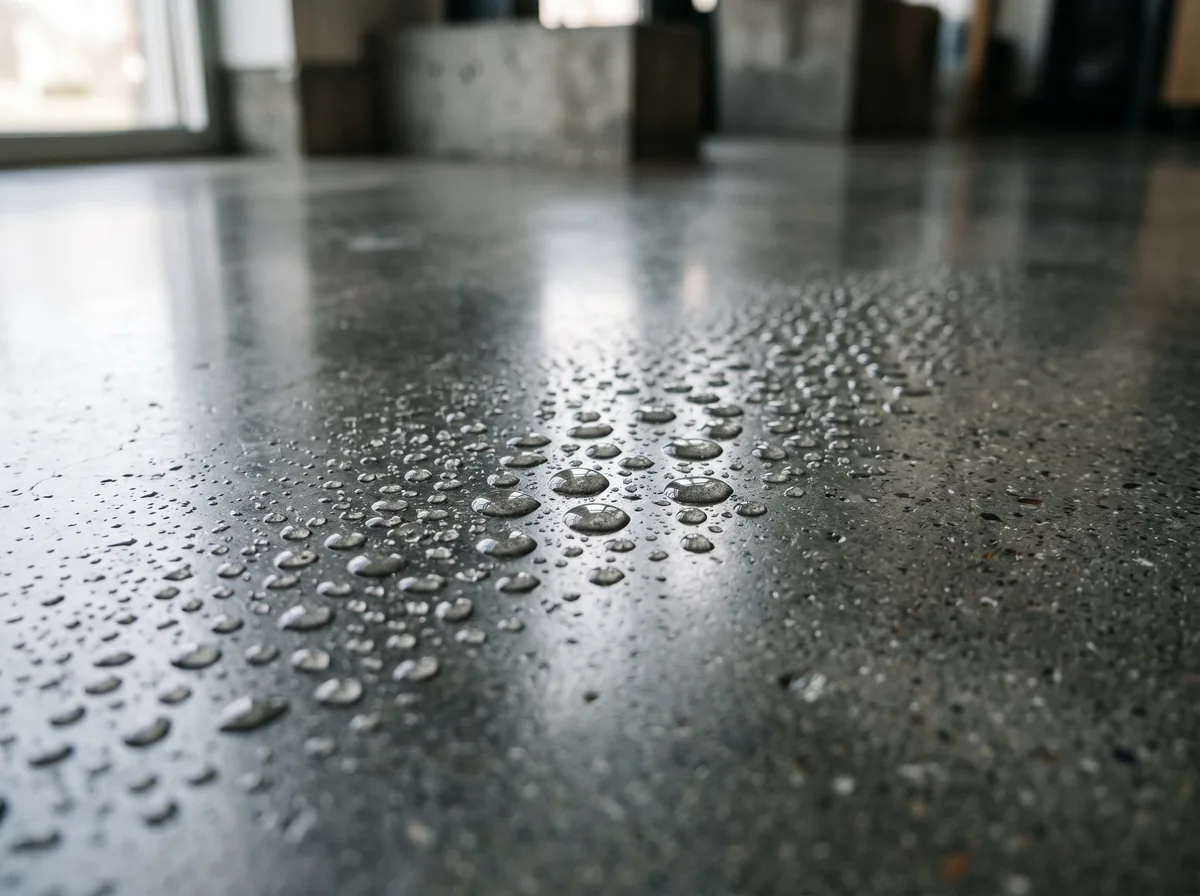
Sweating shows up as a thin film of water, a patch of beaded droplets, or a dark, damp-looking sheen across part of the floor. It appears in the morning or when the weather turns warm and muggy, and often clears once the air and slab temperatures even out. In a basement, garage, or warehouse it can linger for hours and leave the floor genuinely slippery.
People usually mistake it for a leak. The tell is location and timing: a true sweat covers a broad area evenly, follows humid weather, and is worst where the slab is coldest, such as a shaded corner or a section over cool earth. A leak starts at a crack or a joint and does not care what the weather is doing.
Why concrete sweats: the dew point explained
Air always holds some water vapour, and warmer air holds more of it. The dew point is the temperature at which that air becomes saturated and has to release moisture as liquid. When warm, humid air drifts across a slab colder than the dew point, the air right above the concrete cools, hits saturation, and drops its water onto the floor. That is the whole mechanism.
Did you know: concrete stays cold longer than the air
A concrete slab is a huge thermal mass that warms and cools far more slowly than the air. On a morning when the air heats up quickly, the floor lags behind and stays below the dew point for hours. That lag is exactly why a slab sweats even though nothing is leaking into it.
A second, less common cause is hygroscopic salts. De-icing salt and certain curing residues pull moisture out of the air even when the surface is a little above the dew point, which is why a floor exposed to road salt over a GTA winter can sweat more readily than a clean one.
People often ask: is concrete sweat the same as rising damp?
No. Rising damp, or a moisture vapour drive, is water moving up through the slab from the ground below, usually because there is no vapour barrier under the concrete. Sweating slab syndrome is the opposite direction: moisture from the air condensing down onto the surface. The fixes differ, so the two are worth telling apart. If the floor is wet even in dry, cool weather, or the dampness traces back to specific spots rather than the whole slab, suspect a vapour drive and have the slab moisture tested before you seal anything.
Why polished floors show it more
A polished concrete floor is mechanically ground and densified until the surface is tight, smooth, and reflective. That finish gives condensation nowhere to hide. On a rough broom-finished slab a little moisture soaks into the texture and goes unnoticed; on a glossy floor the same moisture sits on top as a visible, slippery film.
The polish does not cause the sweating; the dew point relationship does. But because the surface is so smooth, even a thin layer of condensation can drop the slip resistance sharply, which matters in a showroom, a shop floor, or any space where people walk. If your finish is wearing unevenly too, our guide to keeping polished concrete floors scratch free covers surface care in more depth.
What to try first
Please note: The information here is for general guidance only. Polished Floors is not responsible for any damage, cost, or injury resulting from action taken based on this content. Concrete behaviour depends on the specific slab, sub-base, and moisture conditions on your site; if a step calls for grinding, coating, or moisture testing you are not equipped to do safely, stop and book an on-site assessment with a qualified flooring contractor.
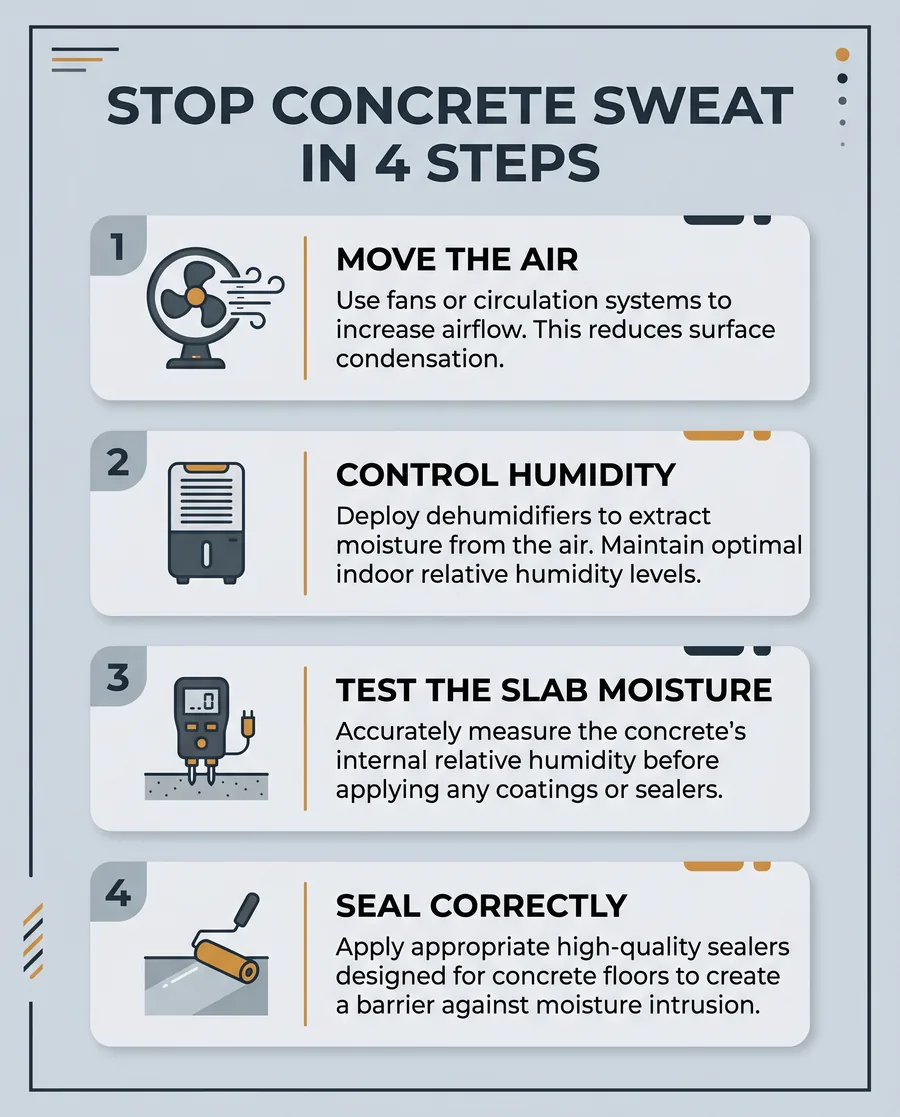
Most sweating is an air management problem before it is a flooring problem. The goal is to stop the slab surface from sitting below the dew point of the air above it. These first steps cost little and often solve it outright.
- Move the air. Fans, especially high-volume low-speed fans in larger spaces, mix the air and warm the surface enough to stop condensation.
- Manage the humidity. A dehumidifier pulls moisture out of the air so it has less to deposit, often the single biggest lever you have.
- Close the temperature gap. Avoid blasting a cold space with warm, moist outdoor air; let the slab and air warm together so the surface stays above the dew point.
- Keep salt and residue off. Clear tracked-in de-icing salt and curing residues that attract moisture and make sweating linger in mild weather.
Pro tip: measure before you guess
An inexpensive thermo-hygrometer plus a simple surface thermometer for the slab will tell you in five minutes whether the floor is sitting below the dew point. If the slab is colder than the room air dew point, you have confirmed a sweat rather than a leak, and you know which lever to pull. Guessing leads to sealing a floor that did not need sealing.

How to prevent it for good
If air management alone does not hold, the next layer is the floor itself. The right approach depends on whether the slab is new or existing, and on what is happening under it.
- A proper vapour barrier under new slabs. For new construction, a continuous vapour retarder between the sub-base and the concrete is the textbook defence against moisture driving up. It is a build-time decision, not a retrofit.
- Densifying and sealing the surface. A lithium or silicate densifier tightens the concrete and a penetrating sealer reduces how readily the surface exchanges moisture. Our guide to concrete densifiers in Toronto explains how densification works.
- A slip-resistant topcoat where needed. In a space that will always be humid, a moisture-suitable coating with anti-slip aggregate restores grip. The wrong coating on a damp slab can blister, the same failure behind a peeling epoxy floor, so the system has to match the conditions.
- Conditioning the space. Insulation, ventilation, and steady climate control keep slab and air temperatures close year round, which removes the root cause.
Pricing note: The figures on this page reflect typical market rates in the Greater Toronto Area as of 2026. What you actually pay depends on the size and condition of the slab, moisture levels, the finish system you choose, and how easy the space is to access. Always get a written quote or on-site assessment before committing to an installation.
| Approach | What it addresses | Typical GTA cost (2026) |
|---|---|---|
| Fans and air circulation | Stops condensation by warming and mixing surface air | $150 to $800 per fan |
| Portable or unit dehumidifier | Lowers room humidity so air carries less moisture | $250 to $2,500 |
| Densify and penetrating sealer | Tightens the surface, reduces moisture exchange | $2 to $5 per sq ft |
| Anti-slip topcoat (suitable system) | Restores grip and protects a humid-area floor | $4 to $9 per sq ft |
| Vapour barrier (new slab only) | Blocks ground moisture driving up | Built into new pour cost |
When to call a flooring contractor
Air management is something you can tackle yourself. The moment the question becomes whether to grind, densify, or coat the floor, it is worth a professional eye, because the wrong product on a damp slab can fail within months. Call a contractor when the floor stays wet despite good ventilation, when the dampness might be a vapour drive rather than a sweat, or when slip safety is a real concern. A contractor can run slab moisture tests, read whether the cause is condensation or a vapour drive, and recommend a system matched to your conditions. We do this across commercial floors and industrial and warehouse slabs throughout the GTA, where sweating slabs are most common and most disruptive.
Sources and further reading
- Polished Floors, in-house installation experience and 2026 GTA market cost observations.
- Wagner Meters, “The Dangers of Concrete That Sweats,” guidance on dew point condensation and slab moisture.
- The Constructor, “Concrete Sweating: Phenomenon, Causes and Prevention,” general explanation of the mechanism.
- O-Town Inspections, “Why Does My Garage Floor Sweat?” (video, embedded above).
Frequently asked questions
Is a sweating concrete floor dangerous?
The water itself is not toxic, but a wet, polished floor is a genuine slip hazard, which is the main risk in a home garage, a shop, or a warehouse aisle. Persistent moisture can also encourage mould growth on nearby materials and, over time, contribute to coating failure if a sealer or epoxy was applied over a slab that keeps getting damp. The moisture is a symptom of the air and slab being out of balance, so the safe move is to fix the underlying condition rather than just mopping the surface every morning.
Will sealing my concrete stop it from sweating?
Sealing can help, but it is not a guaranteed cure on its own, and applied to the wrong slab it can make things worse. Sweating is condensation from the air landing on a cold surface, so the most reliable fixes are air movement, humidity control, and keeping the slab and air temperatures close. A densifier and a quality penetrating sealer reduce how readily the surface exchanges moisture and add some protection, but they should be chosen after the slab is moisture tested. Sealing over a true vapour drive can trap moisture and lead to blistering.
Why does my polished concrete sweat but my neighbour’s textured floor does not?
Both floors are likely condensing the same amount of moisture, but a polished surface shows it and a rough one hides it. A broom-finished or textured slab has tiny pores and ridges that absorb and disperse a thin film of water, so it looks dry while a glossy polished floor displays every droplet on top. The polish does not cause the sweating, it just reveals it, and it also turns that thin film into a slipping risk because the surface is so smooth. The cause and the cure are the same regardless of finish.
How do I tell concrete sweat apart from a leak or rising damp?
Look at the pattern and the timing. A sweat covers a broad area fairly evenly, shows up during warm, humid weather, is worst on the coldest part of the slab, and often clears once temperatures even out. A leak starts at a crack, joint, or wall and does not follow the weather. Rising damp, or a vapour drive, keeps the floor damp even in cool, dry conditions and may show salty white efflorescence. A quick check with a hygrometer and a slab thermometer confirms a sweat, while persistent dampness in dry weather points to a moisture test.
Quick recap
- Concrete sweat is condensation: humid air meets a slab below the dew point and drops moisture onto the surface.
- Polished floors show it more because the smooth, glossy finish displays every droplet and turns slippery fast.
- Air movement, dehumidification, and keeping slab and air temperatures close solve most cases.
- For lasting results, densify and seal correctly, or use a moisture-suitable anti-slip coating where needed.
- If the floor stays wet despite good ventilation, get the slab moisture tested before sealing anything.
Download the free quick guide
Keep our one-page checklist handy so you can diagnose a sweating slab and pick the right fix the first time.
Still fighting a sweating concrete floor in the GTA?
We install and maintain polished concrete and epoxy floors that hold up to GTA conditions. Tell us about your space and we will sort out whether you are dealing with a sweat, a leak, or a vapour drive, then recommend the right fix. Explore our residential flooring services, commercial flooring services, or industrial and warehouse flooring to see how we work.